24/7 cover · Nationwide from Oxfordshire

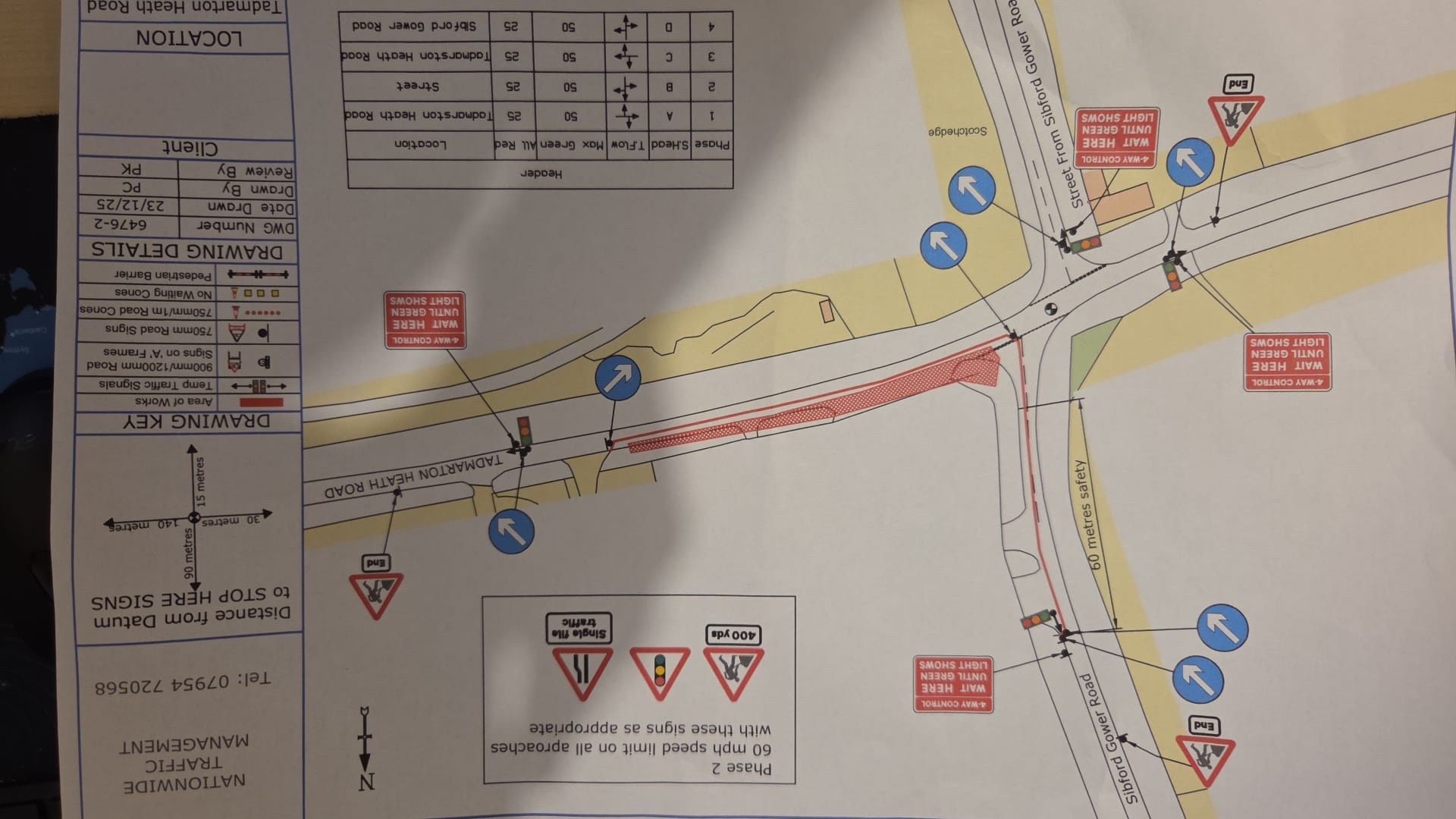
CAD temporary traffic management design drawing showing sign positions and work area layout

CAD drawings & TTM design

CAD Drawings and TTM Designtaken all the way throughto authority approval.

A drawing is only worth what the highway authority accepts and the crew can build. Ours are produced by designers who work alongside the operatives installing them — and we take them through approval rather than handing them to you to argue for.

25 years designing schemes we then deliver · Chapter 8 and NRSWA compliant · Sector Scheme 12A–12D · authority liaison handled end to end · £10m public liability.

25

Years in traffic management

~300

Operatives & staff

~150

Lorries, vans & cars

£10m

Public liability cover

24/7

Cover, including call-outs

The service

Temporary traffic management design, drawn to be built and approved

TTM design is the technical stage that turns a set of works into a buildable, approvable traffic management scheme. It sets out the arrangement, the signing schedule and positions, taper lengths, safety zones, pedestrian and cycle provision, phasing and the installation and removal sequence — everything a crew and an authority both need to see.

We produce scheme-specific CAD drawings rather than generic templates, and we take them through the highway authority for approval as part of the service. Because our designers sit in the same business as the operational team, the design accounts for what can physically be installed on that road, in that width, in the window available.

It suits contractors tendering works who need a scheme and an approval before they can commit to dates, utilities and civils firms whose in-house teams do not include a TTM designer, principal contractors coordinating multiple subcontractors on one street, and clients who have had a drawing rejected and need it resolved.

Professional help matters because approval is where programmes are won or lost. A drawing missing sign schedules, incorrect for the speed limit, or silent on pedestrian provision comes back for revision, and every revision cycle costs calendar time you cannot recover once the crews are booked.

What it costs to get wrong

A rejected drawing costs more than a good design ever would

Approval is not a formality. Authorities check whether the arrangement suits the road type and speed limit, whether taper lengths and sign spacing are right, whether pedestrians and cyclists are provided for, and whether the diversion is viable. A drawing that fails on any of these comes back, and the notice period effectively restarts around it.

The second failure mode is a drawing that gets approved but cannot be built. Designs produced remotely from a template can place signs where there is no verge, specify tapers longer than the available road, or ignore an access, a bus stop or a tree. The crew then improvises on site — which means the installed scheme is not the approved scheme, and the approval no longer protects anybody.

The third cost is coordination. On busy streets several parties often want road space in the same window. Without a properly drawn and phased scheme, conflicts surface on site rather than on paper, and the party who has to move is usually the one whose drawing was vaguest.

Mistakes we are called in to unpick

  • Using a generic template drawing for a specific site, so the dimensions do not match the road that exists.
  • Submitting a design without pedestrian and cycle provision, which is one of the most common reasons for rejection.
  • Designing to the wrong speed limit or road type, producing tapers and sign spacing that will not be accepted.
  • Leaving phasing undefined, so intermediate stages of the works have no compliant arrangement at all.
  • Booking crews and plant before the drawing has been approved, then paying standing time while revisions are made.

Our process

How the scheme gets fromenquiry to signed-off completion

  1. Step 1

    Brief, survey and constraint capture

    We take the works, the road type and speed limit, the duration and the programme, then establish the real constraints: available width, sight lines, junctions and accesses, bus stops, loading, cycle lanes, crossings, street furniture and existing controls.

  2. Step 2

    Arrangement selection

    We determine whether the works call for high-speed TTM, a low-speed urban arrangement, priority working, signals, stop-go or convoy control, a contraflow or a full closure with a signed diversion — and where a hybrid by phase is the better answer.

  3. Step 3

    CAD drawing production

    Drawings are produced with sign schedules and positions, taper and safety zone dimensions, cone spacing, pedestrian and cycle routes, plant crossing points, and the installation and removal sequence, all to Chapter 8 and Sector Scheme 12 requirements.

  4. Step 4

    Phasing and buildability review

    Each phase is checked as a complete compliant arrangement in its own right, and the whole scheme is reviewed against what the crew can actually install in the window available on that road.

  5. Step 5

    Authority submission and approval

    We submit to the highway authority, respond to comments, revise where needed and secure approval, handling the permit or Temporary Traffic Regulation Order alongside so dates and documents line up.

  6. Step 6

    Handover to delivery or to your team

    You receive the approved drawings and documentation. Where we are delivering the scheme, the same drawings brief our operatives; where you are, they are drawn clearly enough for another competent crew to build.

What you get

Specific outcomes,not vague reassurance

Approvals first time, more often
Designs produced to what authorities actually check reduce revision cycles — and revision cycles are calendar time, not just fees.
Drawings a crew can build
Designers work alongside the operational team, so the geometry on the drawing fits the road that exists rather than an idealised one.
Programme certainty earlier
Design and approval handled together means you get confirmed dates rather than an open question in the middle of your programme.
Phasing that holds together
Every stage of the works is a compliant arrangement, so the scheme does not fall apart between phase one and phase two.
One party accountable
If the design and the delivery are ours, there is nobody to blame in the middle when a detail does not work on site.
Documentation for your file
Approved drawings, permits and orders issued to you, delivered under ISO 9001 and our wider accreditations for pre-qualification and audit.

In detail

What a TTM design contains, and how road type changes it

A TTM design is a technical document with a defined content set. The variables are the road, the works and the constraints — but the checklist a competent designer works through is consistent, and it is what authorities assess against.

Drawing content

A scheme drawing shows the works area, the traffic arrangement, safety zones, taper geometry, cone or cylinder spacing, sign types, sizes and positions with a schedule, pedestrian and cycle routes, and any signal head or stop-go positions.

It also shows what is not obvious from a plan: the installation and removal sequence, phasing, plant crossing points, access arrangements within the scheme and the interfaces with adjacent works or permanent street furniture.

Standards the design is produced to

Chapter 8 of the Traffic Signs Manual governs signing, lighting and guarding of works on the highway. The New Roads and Street Works Act governs the permitting and notification framework, and Sector Scheme 12 sets the quality and competency requirements for design and delivery across 12A to 12D.

Design decisions are driven by the permitted speed limit and road type rather than by preference: sign sizes, advance signing distances, taper lengths and safety zone dimensions all scale with speed.

High-speed versus urban design

High-speed designs on dual carriageways and fast single carriageways involve longer distances, larger signs, greater safety zones and a carefully planned installation operation, often within a defined possession window. Getting the sequence right matters as much as getting the layout right.

Urban designs deal with shorter distances but far more competing demands: bus stops, loading bays, taxi ranks, cycle lanes, crossings, resident parking, refuse routes and shop servicing. In practice the consultation is often longer than the drawing.

Diversion route design

Where a closure is proposed, the diversion is part of the design. Routes are checked for height, width and weight restrictions, junction capability for the vehicles displaced, other live works on the route, and bus route implications, with separate HGV routes where restrictions require.

Signing is scheduled junction by junction so drivers get confirmation at every decision point, and sign positions are recorded so replacements go back in the right place.

Pedestrian, cycle and accessibility design

Provision is designed, not annotated. Alternative footway routes need adequate clear width, continuous separation with tapping rails, firm surfaces and ramps where levels change, and defined crossing points where the route changes side.

Cyclists need either a maintained route or a designed merge with clear signing. Designing for wheelchair users, pushchairs and visually impaired pedestrians is an assumption of the design rather than an optional extra.

Approval, revisions and coordination

Approval involves submitting the drawing, answering the authority's technical comments and revising as required. Handling that conversation ourselves is faster than passing comments back and forth through a contractor who did not produce the design.

Where several parties want the same road space, the drawing becomes the coordination tool: phased, dated and specific enough that the authority can see how the works fit together rather than choosing between them.

On site

CAD Drawings & TTM Design we have installed

CAD temporary traffic management design drawing showing sign positions and work area layout

More photography from live schemes is on our our work gallery.

Standards this work is delivered to

  • Sector Scheme 12 — 12A, 12B, 12C & 12D
  • Chapter 8 (Traffic Signs Manual)
  • New Roads & Street Works Act (NRSWA)
  • Lantra/NRSWA cards, T1/T2/T3 tickets
  • £10m public liability & £10m employers' liability insurance

Accreditations held

  • National Highway Sector Schemes
  • Constructionline Gold
  • BM Trada
  • CHAS
  • Acclaim
  • Achilles UVDB
  • Avetta
  • Builder's Profile
  • SafeContractor
  • ISO 9001

Certificates are issued for your pre-qualification pack on request. We work direct for end clients and as a subcontractor to principal contractors.

Straight answers

CAD Drawings & TTM Designquestions we are asked

How much does a TTM design cost?

Design fees depend on the complexity of the scheme, the number of phases and drawings required, whether a diversion route has to be surveyed and signed, and how much authority liaison the approval needs. A single-phase footway closure is a small piece of work; a multi-phase high street scheme with a diversion is not. We quote per scheme in writing.

How long does it take to get a drawing approved?

The design itself is usually the quicker part. Authority approval and the associated permit or order notice periods dominate the timeline and vary by authority and works type, with TTROs taking the longest. The practical advice is to start design as soon as you have an indicative programme.

Can you design a scheme that another contractor will install?

Yes. Drawings are produced clearly enough for any competent traffic management contractor to build, with sign schedules, dimensions and sequences specified rather than implied. We will tell you honestly where a detail depends on judgement on the day.

What if the authority rejects the design?

We handle the comments and the revision as part of taking the scheme through approval — that is the point of us owning the conversation rather than passing it to you. Where an authority requires a materially different arrangement, we explain the programme and cost implications before proceeding.

Do you handle permits and TTROs as well as the design?

Yes. Authority liaison is handled end to end: permit applications, Temporary Traffic Regulation Orders, notice periods, consultation and council sign-off, all aligned with the approved drawing so documents and dates match.

Do you need to visit the site to design a scheme?

For anything other than the simplest arrangements, yes, and it is what stops a drawing being unbuildable. Available width, sight lines, accesses, street furniture and existing controls are frequently not what mapping suggests, and diversion routes should be driven before they are signed.

What standards do you design to?

Chapter 8 of the Traffic Signs Manual, the New Roads and Street Works Act framework, and Sector Scheme 12 across 12A, 12B, 12C and 12D. We also hold ISO 9001 along with Constructionline, CHAS, SafeContractor, Achilles UVDB, Acclaim and BM Trada.

Can you redesign a scheme that is already on site and not working?

Yes, and it is a common call. We review the installed arrangement against the approval, identify what is causing the problem — usually siting, timings, phasing or pedestrian provision — and produce a revised design and approval rather than continuing to adjust it on the day.

Will the same team deliver the scheme they designed?

If you want us to, yes, and it is the arrangement we would recommend. Design and delivery in one business removes the gap where site conditions get lost between the drawing and the crew.

Which areas do you design schemes for?

Anywhere we work, which is nationwide: Oxfordshire and Oxford, London and all boroughs, the South East, Gatwick, the South West, Wales, the Midlands, the North and Scotland. Authority processes differ by area, which is part of what we handle for you.

Related services

  • Permits & TTROs

    Permit applications, Temporary Traffic Regulation Orders and local authority liaison handled end to end. Oxfordshire base, nationwide coverage, 25 years of authority experience.

  • Traffic Management

    Temporary traffic management in Oxfordshire and nationwide: TTM design, permits, signals, signage and ticketed crews from one contractor. 25 years, 24/7 cover, £10m insurance.

  • Road & Lane Closures

    Full road closures, lane closures and contraflows in Oxfordshire and nationwide. Signed diversion routes, TTRO and permit handling, ticketed crews, 24/7 cover, £10m insurance.

  • High-Speed Traffic Management

    Sector Scheme 12D high-speed traffic management on dual carriageways and fast roads. Lane closures, contraflows, ticketed crews, Oxfordshire base, nationwide cover, £10m insurance.

Where we deliver it

Based in Oxfordshire and working nationwide. See the full service areas list, browse all traffic management services, read about the company, or return to the homepage.

  • Oxfordshire
  • Oxford
  • Banbury
  • Bicester
  • Witney
  • Abingdon-on-Thames
  • Didcot
  • Kidlington
  • London
  • South East
  • Gatwick
  • South West
  • Wales
  • Midlands
  • North
  • Scotland

Send us the works.We will draw the schemeand get it approved.

Give us the road, the works and your target dates. You get a written estimate for the design and the authority approval, with delivery by our own crews if you want it.

25 years · Sector Scheme 12A–12D · £10m public liability · 24/7 cover

Send the details

Road type, duration and start date is enough to price it. We reply to every enquiry.