24/7 cover · Nationwide from Oxfordshire

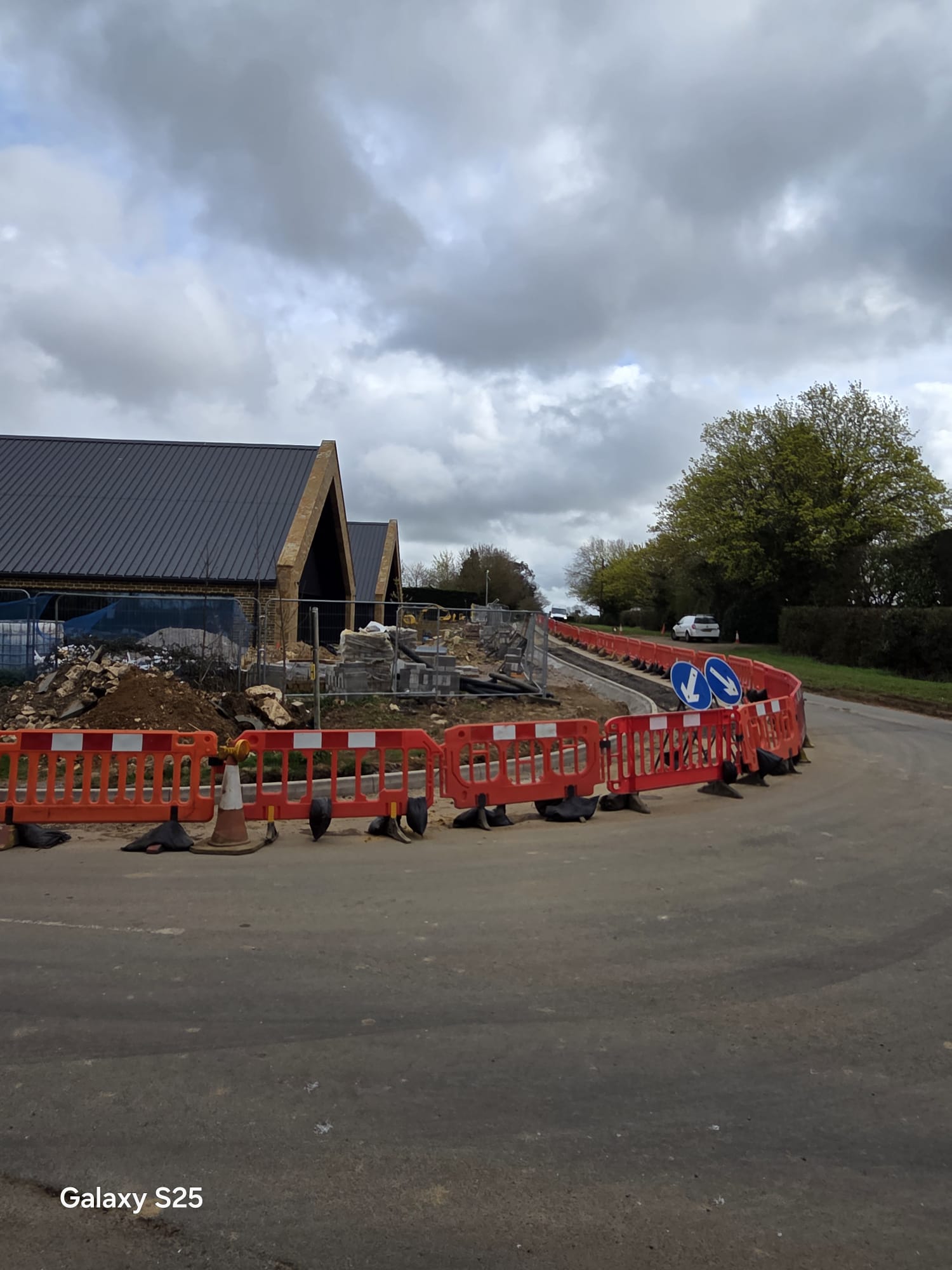
Barriers, cones and keep-left signs guiding traffic around a new kerb line on a low-speed scheme

Signage · supplied, installed, maintained

Chapter 8 Signage supplied,installed and maintainedacross Oxfordshire and the UK.

Signs are how a scheme communicates. Positioned correctly, they prevent the confusion that causes incidents and complaints — and we keep them clean, upright and in the right place for the whole duration, not just on day one.

Chapter 8 compliant · advance warning, diversion and information signing · sign positions recorded for accurate replacement · 24/7 call-out · £10m public liability.

25

Years in traffic management

~300

Operatives & staff

~150

Lorries, vans & cars

£10m

Public liability cover

24/7

Cover, including call-outs

The service

Advance warning, diversion and information signage for works on the highway

Signage is the part of temporary traffic management that talks to the public. Advance warning signs tell drivers what is ahead and give them time to react. Diversion signing guides displaced traffic along a route junction by junction. Information signs tell residents, businesses and pedestrians what is happening, for how long, and how to get where they are going.

We supply, install and maintain the full range to Chapter 8 of the Traffic Signs Manual: works ahead and hazard signs, lane and road closure signs, diversion route signing including separate HGV routes, pedestrian route signing, business-open and access signing, and project information boards. Sign positions are recorded so a stolen or damaged sign goes back exactly where it belongs.

It suits any works on or beside a road: street works, resurfacing, structures, developer site accesses, events needing wayfinding and marshalled crossings, and film production requiring public notice. It works both as part of a full traffic management scheme and as a standalone supply-and-install requirement.

Professional help matters because sign compliance is about placement as much as product. The right sign in the wrong position — too close to the hazard, hidden behind vegetation, angled away from approaching traffic, or the wrong size for the approach speed — communicates nothing, and is a finding an inspector can act on.

What it costs to get wrong

Signs that nobody can read are the same as no signs at all

Signing is the most visible part of a scheme and the part most likely to degrade. Signs get stolen, blown over, turned around by the public, obscured by parked vehicles or overgrowth, and coated in road dirt until they are unreadable at night. None of that shows up on the drawing, and all of it shows up in an incident report.

For diversions the failure is more immediate. Miss a confirmatory sign at one junction and drivers make their own decision, which typically means the diversion collapses and traffic finds its way back into the closure. That produces the complaints, the authority attention and, in some cases, a vehicle in your working area.

The commercial impact is quieter but real. Businesses within a closure whose access is not signed lose trade and escalate to the council, and the council's response is usually to constrain your working hours or ask for changes mid-scheme. Signing residents and businesses properly is far cheaper than the negotiation that follows not doing it.

Mistakes we are called in to unpick

  • Using signs too small for the approach speed, so drivers cannot read them in time to act.
  • Positioning signs where vegetation, parked vehicles or street furniture hides them from approaching traffic.
  • Missing confirmatory diversion signs at intermediate junctions, so drivers abandon the route.
  • Leaving signs in place after the works finish, sending drivers along a diversion that no longer exists.
  • Never cleaning or resetting signs on a long-duration scheme, so night-time reflectivity quietly disappears.

Our process

How the scheme gets fromenquiry to signed-off completion

  1. Step 1

    Sign schedule and route survey

    We establish what has to be communicated and to whom, then survey the approaches and, for closures, drive the diversion route to fix sign types, sizes and positions junction by junction.

  2. Step 2

    Schedule drawing and approval

    Sign positions and types are drawn as part of the scheme and taken through highway authority approval with the permit or order, so the signing installed is the signing that was accepted.

  3. Step 3

    Supply and installation

    Signs are supplied on frames, posts or vehicles as the location requires and installed by our own operatives at the surveyed positions, with the correct spacing for the approach speed and sizes appropriate to the road.

  4. Step 4

    Recording and handover

    Installed positions are recorded so that replacements go back in the correct place, and the schedule is issued to you as part of the scheme documentation.

  5. Step 5

    Inspection, cleaning and replacement

    Through the scheme we inspect, straighten, clean and replace signs, respond to thefts and damage, and adjust where site conditions change. 24/7 call-out covers the overnight failures.

  6. Step 6

    Removal and confirmation

    At completion every sign is removed, including the full diversion route, and the removal is confirmed — so nobody is following an obsolete route a fortnight after you left.

What you get

Specific outcomes,not vague reassurance

Signing that reads at speed and at night
Correct sizes for the approach speed, clean reflective faces and positions with real sight lines, maintained through the scheme rather than assumed.
Diversions that hold together
Confirmatory signing at every junction, with separate HGV routes where restrictions apply, so displaced traffic stays on the intended route.
Replacements in the right place
Recorded positions mean a stolen sign is replaced exactly, not approximately — which matters most on long diversion routes.
Fewer complaints from businesses
Access and business-open signing keeps trade visible during works, which removes one of the most common escalation routes to the authority.
Nothing left behind
Full removal at completion, confirmed, so drivers are not following a diversion to works that finished last month.
Standalone or part of the scheme
Supplied on its own, or as part of a full traffic management package with signals, barriers, permits and crews on one order.

In detail

Sign types, mounting, sizing and route signing practice

Signing decisions come down to what has to be communicated, at what speed it will be read, and how the sign will survive where it is placed. Below is the detail behind those decisions.

Advance warning and hazard signing

Advance signs give drivers time to interpret and react: works ahead, lane closures, road narrowing, temporary signals, and specific hazards such as loose chippings or ramps. Spacing from the hazard is set by the permitted speed, which is why the same scheme signs differently on a 30mph street and a dual carriageway.

Supplementary plates and distance plates carry the detail that makes the primary sign useful, and lamps are used where required to maintain conspicuity in darkness.

Diversion route signing

A diversion needs advance information before the decision point and confirmation at every junction along the route, so nobody has to guess. Where the route differs for HGVs because of height, weight or width restrictions, a separate route is signed.

Routes are driven before signing, sign positions are recorded, and the whole route is inspected during the works because remote sections are where signs disappear unnoticed.

Pedestrian, cycle and access signing

Pedestrian route signing tells people where the alternative footway goes and where it crosses the road, and needs to be positioned at eye level where it will actually be seen rather than among the vehicle signs.

Access signing keeps businesses and residents functioning: business-open signs, access maintained signs, delivery routing and residents access signing. On developer sites, site entrance and vehicle routing signage keeps deliveries out of residential streets.

Mounting, materials and durability

Signs are mounted on frames, posts, verge sockets or vehicles depending on the location, exposure and duration. Frame ballast and stability matter in exposed positions where wind will otherwise flatten a sign overnight.

For long-duration schemes durability becomes the priority: reflective faces that survive months of road spray, fixings that resist interference, and a cleaning and resetting regime that keeps conspicuity where it was on day one.

Information boards and project signing

Longer schemes benefit from information signing that explains what the works are, roughly how long they will last and who to contact. It measurably reduces complaint volume because people who understand a scheme tolerate it better.

For events and film production, wayfinding and public information signing is often as important as the traffic signing, guiding pedestrian flows and setting expectations before people arrive at a controlled crossing.

Inspection regimes and standalone supply

Inspection frequency depends on the scheme duration, road type and exposure. It covers uprightness, cleanliness, correct angle, obscuration by vegetation or parked vehicles, and completeness against the schedule — and it is recorded, which is what an authority or client audit will ask for.

Where you have your own crews, we can supply and install signing as a standalone package and maintain it, or supply to your positions and leave the upkeep with you. We will say which we would recommend for the location.

On site

Signage we have installed

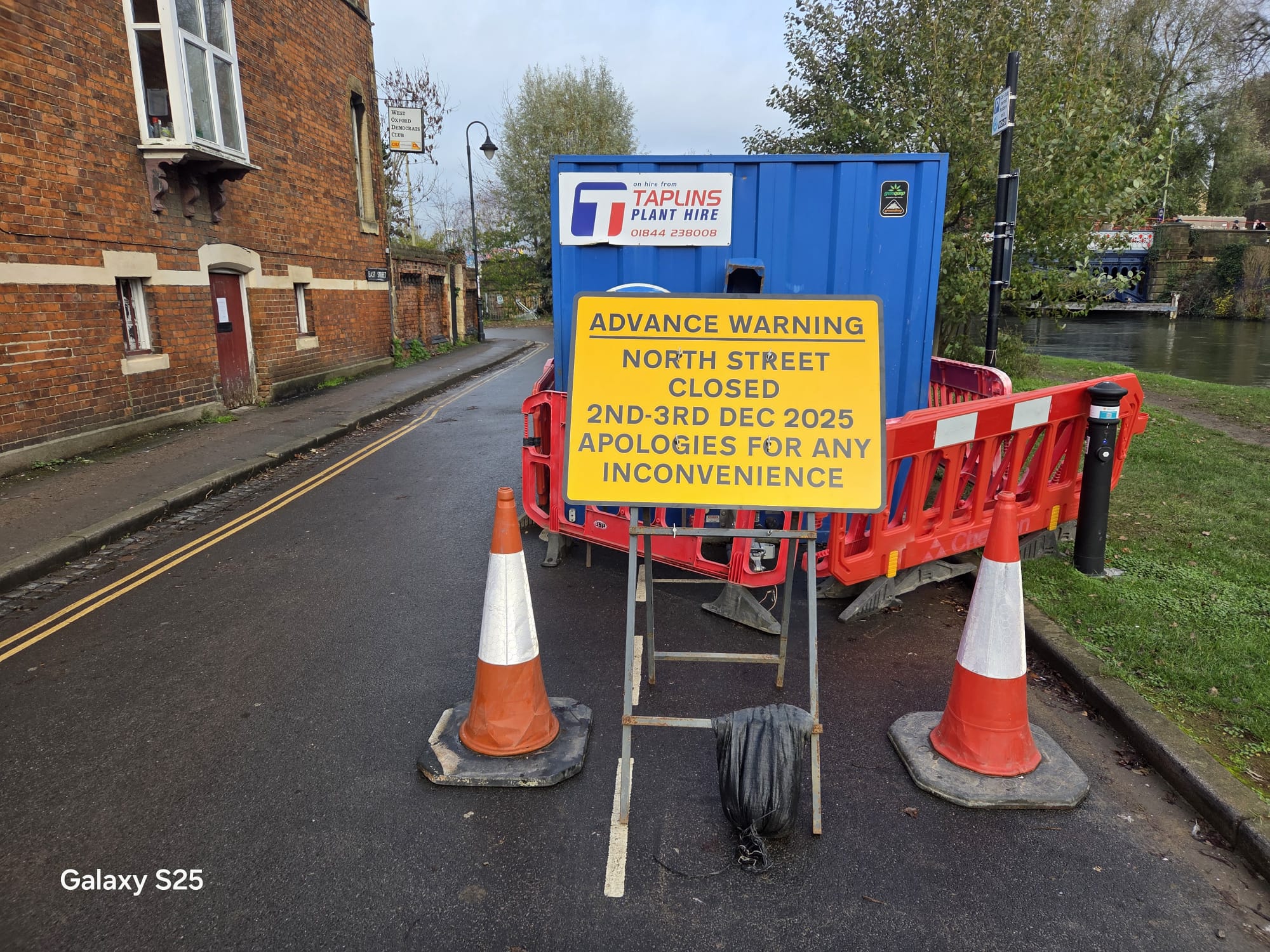
Yellow advance warning sign on cones giving notice of a street closure and its dates
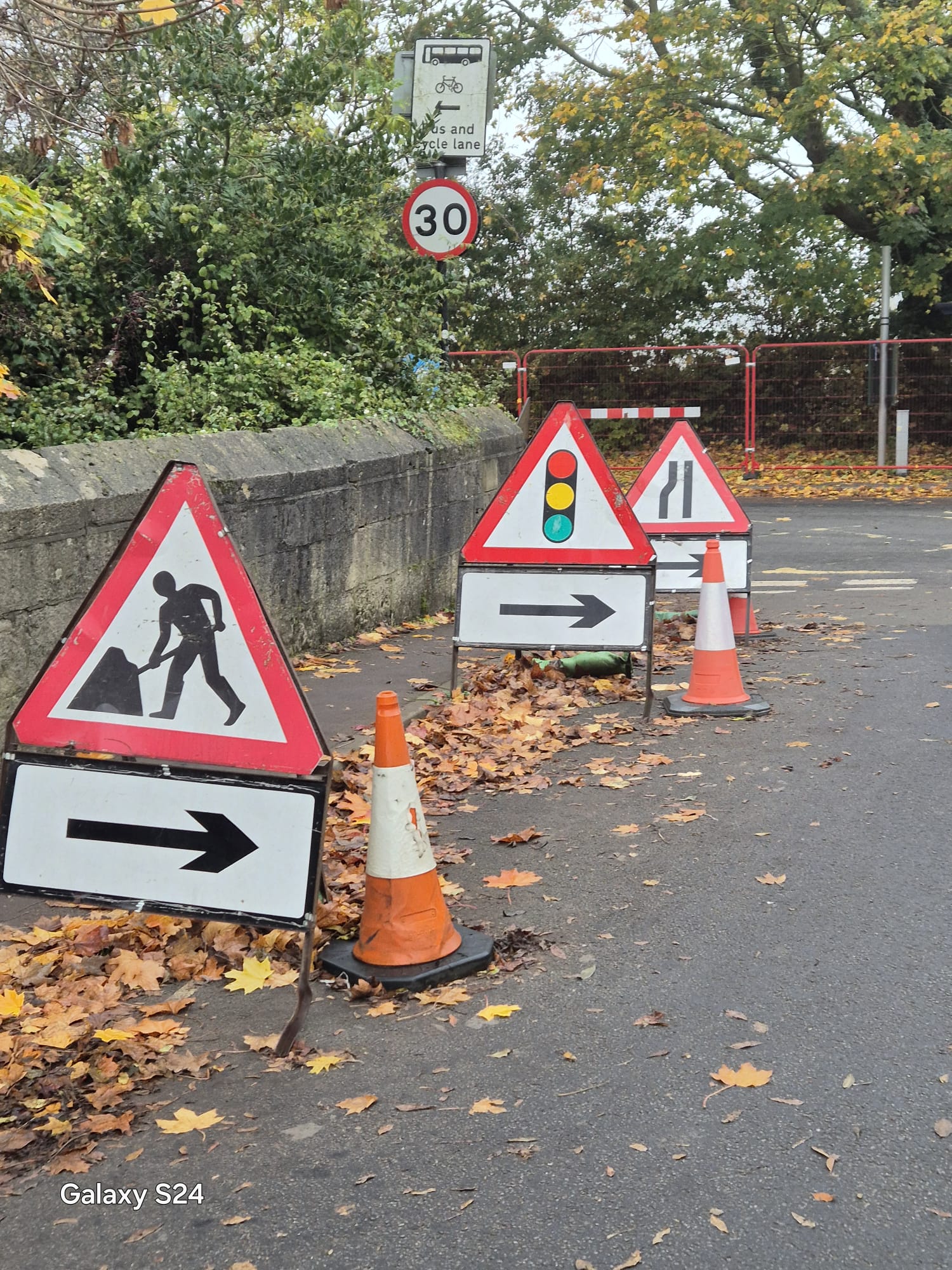
Road works, traffic signals ahead, road narrows and arrow signs set out on cones at a work site approach

More photography from live schemes is on our our work gallery.

Standards this work is delivered to

  • Sector Scheme 12 — 12A, 12B, 12C & 12D
  • Chapter 8 (Traffic Signs Manual)
  • New Roads & Street Works Act (NRSWA)
  • Lantra/NRSWA cards, T1/T2/T3 tickets
  • £10m public liability & £10m employers' liability insurance

Accreditations held

  • National Highway Sector Schemes
  • Constructionline Gold
  • BM Trada
  • CHAS
  • Acclaim
  • Achilles UVDB
  • Avetta
  • Builder's Profile
  • SafeContractor
  • ISO 9001

Certificates are issued for your pre-qualification pack on request. We work direct for end clients and as a subcontractor to principal contractors.

Straight answers

Signagequestions we are asked

How much does road works signage cost?

It depends on the number and size of signs, whether frames or posts are used, the hire duration, and how much installation and inspection the location needs. A short advance signing set is inexpensive; a long HGV diversion route with confirmatory signing at every junction is a much larger schedule. We price the specific schedule in writing.

Do you install the signs or just supply them?

Both are available, and we would normally recommend installation by us. Compliance depends on position, spacing and sight lines as much as on the sign itself, so signs dropped off for site staff to place is where most non-compliance originates.

Are your signs Chapter 8 compliant?

Yes. Signage is supplied and installed to Chapter 8 of the Traffic Signs Manual, within schemes delivered under Sector Scheme 12 registration across 12A to 12D and to NRSWA requirements.

What happens if a sign is stolen or knocked over?

We replace it, and because installed positions are recorded, it goes back in the correct place rather than approximately. Inspection and replacement are part of the scheme, with 24/7 call-out for overnight losses on critical positions.

How long can I hire signage for?

From a single day to the full duration of a long-term site access scheme. Long hires include the inspection, cleaning and resetting needed to keep night-time conspicuity and compliance where they started.

Can you sign a full diversion route?

Yes, including driving the route beforehand to check height, width and weight restrictions, providing separate HGV routing where needed, signing every junction on the route, recording positions and removing the whole route at completion.

Do you provide signage for events and film work?

Yes. Events and film and TV are sectors we work in, and both need public information and wayfinding signing alongside the traffic signing — often installed and removed within a very tight window around a fixed date.

Do you handle the permit for the signing?

Yes, where the works require one. Authority liaison including permit applications and Temporary Traffic Regulation Orders is handled end to end, with the sign schedule submitted as part of the scheme.

Will you remove everything when the works finish?

Yes, and the removal is confirmed. Signs left in place after completion, particularly on a diversion route, are one of the most common sources of authority complaints against a works promoter.

Which areas do you cover?

Oxfordshire and Oxford as our base area, plus London and all boroughs, the South East, Gatwick, the South West, Wales, the Midlands, the North and Scotland, supported by around 150 lorries, vans and cars.

Related services

  • Road & Lane Closures

    Full road closures, lane closures and contraflows in Oxfordshire and nationwide. Signed diversion routes, TTRO and permit handling, ticketed crews, 24/7 cover, £10m insurance.

  • Traffic Management

    Temporary traffic management in Oxfordshire and nationwide: TTM design, permits, signals, signage and ticketed crews from one contractor. 25 years, 24/7 cover, £10m insurance.

  • Barriers & Access Control

    Pedestrian and vehicle barriers, separators, ground protection and controlled site access points supplied, installed and maintained. Oxfordshire base, nationwide cover, £10m insurance.

  • CAD Drawings & TTM Design

    Scheme-specific CAD drawings and temporary traffic management design, taken through highway authority approval. Chapter 8 and Sector Scheme 12 compliant. Oxfordshire base, UK-wide.

Where we deliver it

Based in Oxfordshire and working nationwide. See the full service areas list, browse all traffic management services, read about the company, or return to the homepage.

  • Oxfordshire
  • Oxford
  • Banbury
  • Bicester
  • Witney
  • Abingdon-on-Thames
  • Didcot
  • Kidlington
  • London
  • South East
  • Gatwick
  • South West
  • Wales
  • Midlands
  • North
  • Scotland

Send us the scheme.We will schedule the signsand keep them readable.

Give us the location, the works and the duration. You get a written estimate covering the sign schedule, installation, inspection and full removal at completion.

25 years · Sector Scheme 12A–12D · £10m public liability · 24/7 cover

Send the details

Road type, duration and start date is enough to price it. We reply to every enquiry.