24/7 cover · Nationwide from Oxfordshire

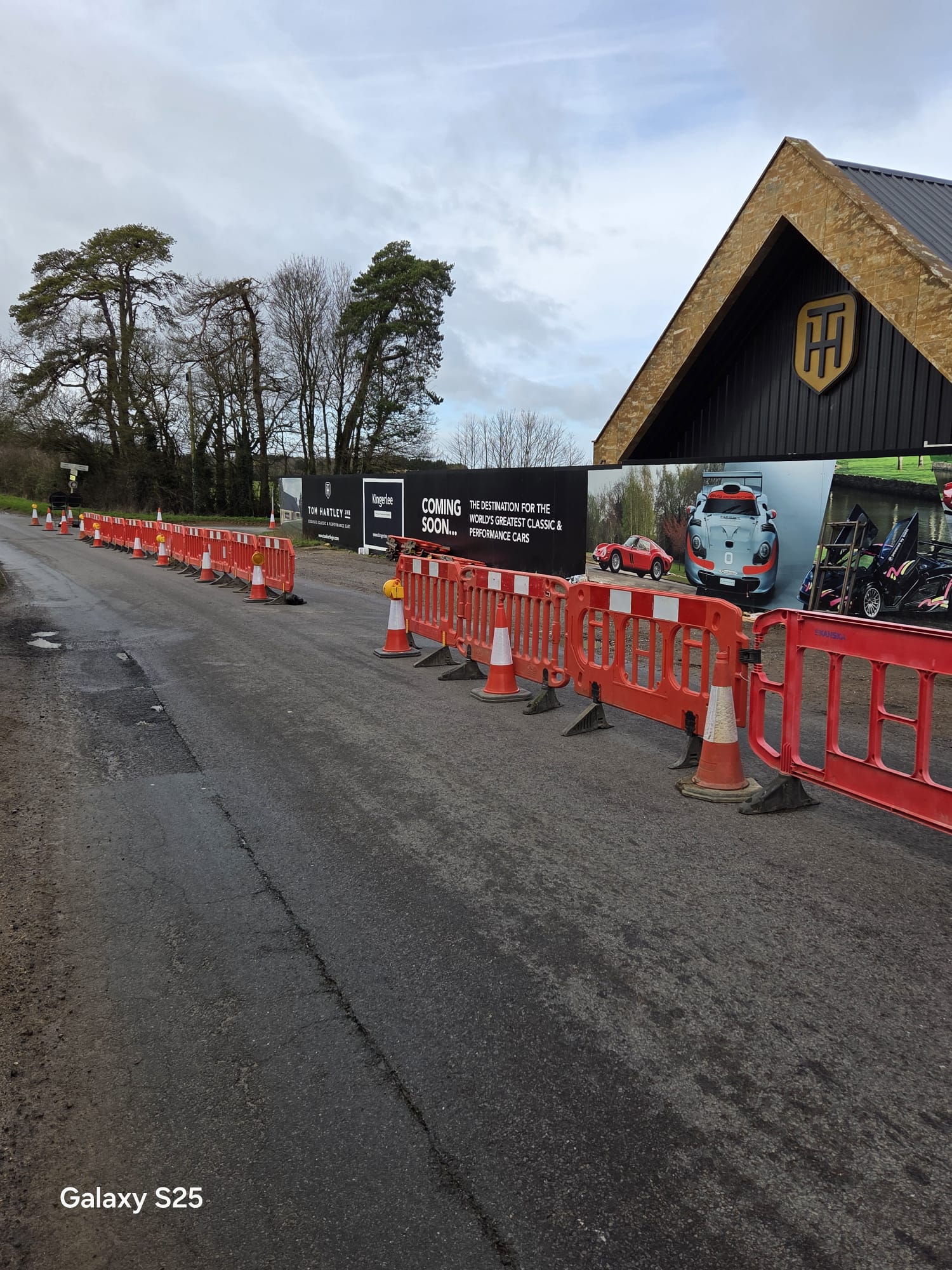
Barriers and cones set out along a public road in front of construction hoarding

Site safety & professional services

Site Safety and Traffic ManagementCoordination for Oxfordshireand UK-wide projects.

The measures that stop an incursion becoming an injury, and the coordination that stops three subcontractors designing three conflicting schemes on the same street.

25 years on live highways · traffic management coordination · incursion prevention and warning systems · dynamic speed signage · Sector Scheme 12A–12D · £10m public liability.

25

Years in traffic management

~300

Operatives & staff

~150

Lorries, vans & cars

£10m

Public liability cover

24/7

Cover, including call-outs

The service

Coordination, monitoring and protective systems for works on live roads

Beyond installing a scheme, projects need somebody making sure the whole traffic management picture holds together: that phases align, that subcontractors are not each designing their own arrangement, that authority conditions are being complied with, and that the measures on site match the approved drawing. That is traffic management coordination.

Alongside it sit the protective systems that reduce risk where a working space is close to live traffic: incursion prevention and warning systems that alert the workforce when a vehicle enters the safety zone, dynamic speed signage that shows drivers their actual approach speed, and monitoring that records what is happening rather than relying on recollection.

It suits principal contractors running multi-phase or multi-subcontractor projects, highways and civils frameworks, local authorities managing several promoters on one network, and any project where the working space sits near a fast running lane or where a location has a history of incursions.

Professional help matters because these are the items most often left to nobody in particular. Coordination that is everybody's responsibility is nobody's, and protective systems specified as an afterthought are usually specified too late to prevent the event they were meant to prevent.

What it costs to get wrong

The gaps between competent parties are where incidents live

On a project with several subcontractors, each may be individually compliant while the combined arrangement is not. Two approved schemes overlapping in the same window, a pedestrian route that ends where another party's hoarding begins, a phase change with no defined transition — these are coordination failures, and none of them show up on a single drawing.

Incursions are the second theme. A vehicle entering a safety zone gives the workforce very little warning, and on higher-speed roads none at all without a system to provide it. Locations with a history of incursions keep producing them until the arrangement or the protective measures change.

The third cost is evidentiary. When something happens, the question is what the arrangement was, when it was last inspected, what had been reported and what was done about it. Projects with no coordination and no monitoring records answer that question badly, which is expensive regardless of who was actually at fault.

Mistakes we are called in to unpick

  • Assuming each subcontractor's compliant scheme adds up to a compliant project-wide arrangement.
  • Leaving phase transitions undefined, so there is a period where no approved arrangement is in place.
  • Treating incursion prevention and warning systems as an optional extra on schemes right beside a fast running lane.
  • Ignoring recurring incursions at a known location rather than changing the arrangement or adding protective measures.
  • Keeping no inspection or incident records, so the project cannot evidence what the arrangement was on any given day.

Our process

How the scheme gets fromenquiry to signed-off completion

  1. Step 1

    Project review and risk profiling

    We review the works, the phases, the parties involved and the road environment, then identify where the traffic management risk actually sits — usually at interfaces, transitions and locations where the working space is closest to live traffic.

  2. Step 2

    Coordination framework

    We establish who is responsible for which arrangement, how phases hand over, how changes are approved, and how authority conditions are tracked, so there is one coherent picture rather than several partial ones.

  3. Step 3

    Protective measure specification

    Where the risk profile justifies it we specify incursion prevention and warning systems, dynamic speed signage and additional delineation or conspicuity measures, sized to the road and the exposure rather than applied generically.

  4. Step 4

    Installation and integration

    Systems and measures are installed and integrated with the traffic management scheme so they work with the arrangement rather than alongside it, and the workforce is briefed on what each system does and what to do when it activates.

  5. Step 5

    Monitoring, inspection and reporting

    Arrangements are inspected, incursions and incidents are recorded and reported to you, and recurring problems are escalated with a recommendation to change the arrangement rather than repeat it.

  6. Step 6

    Review and close-out

    At phase ends and project completion we review what happened, confirm removal of temporary measures, and hand over the records for your own file and your client's audit.

What you get

Specific outcomes,not vague reassurance

One coherent traffic management picture
Phases, parties and authority conditions coordinated, so gaps at interfaces and transitions are closed before they become incidents.
Warning where drivers give none
Incursion prevention and warning systems give the workforce notice that a vehicle has entered the safety zone — the warning the road itself will not provide.
Approach speeds moderated
Dynamic speed signage shows drivers their actual speed on approach, which is one of the more effective low-cost interventions available.
Recurring problems fixed, not repeated
Recorded incursions and incidents mean a known problem location gets a changed arrangement instead of another entry in the log.
Evidence when it matters
Inspection and incident records that answer what the arrangement was, when it was checked and what was done — delivered under ISO 9001 and our wider accreditations.
Support from a delivery contractor
Advice from a business that installs schemes daily with around 300 operatives, not from a consultant who has never had to build the drawing.

In detail

Coordination scope, protective systems and monitoring in practice

These services are specified against the actual risk on your project rather than as a package. The detail below sets out what each element covers and where it earns its cost.

Traffic management coordination

Coordination covers the whole traffic management picture on a project: phase sequencing, interfaces between parties, transitions between arrangements, compliance with authority conditions, and consistency between the approved drawings and what is installed.

On projects with several promoters or subcontractors it also means being the single party the authority can talk to about road space, which resolves clashes on paper instead of on site.

Incursion prevention and warning systems

These systems detect a vehicle entering the safety zone and alert the workforce, giving people in the working space time to move. They are most valuable where the working space is close to a fast running lane, at night, and at locations with a history of incursions.

They are a risk-reduction layer rather than a substitute for correct geometry. Advance signing, taper length and safety zone dimensions still do the primary work; the system covers the case where a driver ignores all of it.

Dynamic speed signage

Signage that displays a driver's actual approach speed changes behaviour more reliably than a static limit sign alone, particularly on approaches where the temporary limit is well below the permanent one.

It also generates speed data for the approach, which is useful evidence when discussing an arrangement with the highway authority or justifying additional measures at a problem location.

Inspection, monitoring and reporting

Inspection regimes are set by scheme duration, road type and exposure, and cover completeness against the drawing, sign condition and conspicuity, barrier continuity, signal operation and pedestrian route integrity.

Records are the deliverable: what was inspected, what was found, what was corrected, what incursions or incidents occurred, and what was recommended as a result. That is what a client or authority audit asks for.

Compliance, competency and pre-qualification support

Schemes are delivered under Sector Scheme 12 registration across 12A to 12D, to Chapter 8 of the Traffic Signs Manual and to NRSWA requirements, with operatives holding Lantra and NRSWA cards and T1, T2 and T3 tickets.

For pre-qualification we hold Constructionline, CHAS, SafeContractor, Achilles UVDB, Acclaim, BM Trada and ISO 9001, with £10 million public liability and £10 million employers' liability cover. Certificates are issued on request for your own client packs.

Working with your project systems

We work direct for end clients and as a subcontractor to main and principal contractors, aligning with your site induction, RAMS process, permit-to-work system and reporting formats rather than imposing a parallel set.

Where your project already has a coordination function, we support it with the traffic management detail; where it does not, we provide it. Either way there is one accountable party for the arrangement on the road.

Standards this work is delivered to

  • Sector Scheme 12 — 12A, 12B, 12C & 12D
  • Chapter 8 (Traffic Signs Manual)
  • New Roads & Street Works Act (NRSWA)
  • Lantra/NRSWA cards, T1/T2/T3 tickets
  • £10m public liability & £10m employers' liability insurance

Accreditations held

  • National Highway Sector Schemes
  • Constructionline Gold
  • BM Trada
  • CHAS
  • Acclaim
  • Achilles UVDB
  • Avetta
  • Builder's Profile
  • SafeContractor
  • ISO 9001

Certificates are issued for your pre-qualification pack on request. We work direct for end clients and as a subcontractor to principal contractors.

Straight answers

Site Safety & Professional Servicesquestions we are asked

How much do these services cost?

Coordination is priced on the scope and duration of the project involvement; protective systems are priced on the equipment, installation and hire period. Both are specified against the actual risk on your scheme, so we quote them individually in writing rather than as a bundled package.

What does traffic management coordination actually involve?

Making the whole picture coherent: phase sequencing, interfaces between parties, transitions between arrangements, compliance with authority conditions, and keeping installed arrangements consistent with approved drawings. On multi-promoter projects it also means being the single point of contact for the authority on road space.

When should I specify incursion prevention or warning systems?

When the working space sits close to a fast running lane, when working at night on high-speed roads, and at any location with a history of incursions. They are a layer on top of correct geometry, not a replacement for it, and they are far more useful specified at design stage than after an event.

Does dynamic speed signage actually reduce speeds?

Showing drivers their own speed is generally more effective than a static sign alone, particularly where a temporary limit is well below the permanent one. It also produces approach speed data, which is useful when justifying further measures to the highway authority.

How often will the scheme be inspected?

Frequency is set by the scheme duration, the road type and the exposure, and it is agreed up front so both sides know what is being delivered. Inspections are recorded, covering completeness against the drawing, sign condition, barrier continuity, signal operation and pedestrian route integrity.

Will you work under our existing safety management system?

Yes. We align with your site induction, RAMS process, permit-to-work system and reporting formats. Where you already have a coordination function we support it with traffic management detail rather than duplicating it.

Can you provide these services on a project you are not delivering the traffic management for?

Yes, though there are advantages to combining them. Where another contractor is installing the scheme, our role is reviewing, coordinating and monitoring, and we will report honestly on what we find rather than smoothing it over.

What accreditations and insurance do you hold?

Constructionline, BM Trada, CHAS, Acclaim, Achilles UVDB, SafeContractor and ISO 9001, with Sector Scheme 12 registration across 12A to 12D, plus £10 million public liability and £10 million employers' liability cover. Certificates are available for your pre-qualification pack.

Do you provide out-of-hours monitoring?

Yes. We operate 24/7, including emergency rapid-response call-outs, so overnight faults, damage and incursions are attended and recorded at the time rather than found the following morning.

Which areas do you provide these services in?

Nationwide from our Oxfordshire base: Oxford, London and all boroughs, the South East, Gatwick, the South West, Wales, the Midlands, the North and Scotland.

Related services

  • High-Speed Traffic Management

    Sector Scheme 12D high-speed traffic management on dual carriageways and fast roads. Lane closures, contraflows, ticketed crews, Oxfordshire base, nationwide cover, £10m insurance.

  • Traffic Management

    Temporary traffic management in Oxfordshire and nationwide: TTM design, permits, signals, signage and ticketed crews from one contractor. 25 years, 24/7 cover, £10m insurance.

  • Barriers & Access Control

    Pedestrian and vehicle barriers, separators, ground protection and controlled site access points supplied, installed and maintained. Oxfordshire base, nationwide cover, £10m insurance.

  • Night Works & Emergency Response

    Out-of-hours and night traffic management plus 24/7 emergency rapid-response call-outs. Oxfordshire base, nationwide cover, ticketed crews, Sector Scheme 12A–12D, £10m insurance.

Where we deliver it

Based in Oxfordshire and working nationwide. See the full service areas list, browse all traffic management services, read about the company, or return to the homepage.

  • Oxfordshire
  • Oxford
  • Banbury
  • Bicester
  • Witney
  • Abingdon-on-Thames
  • Didcot
  • Kidlington
  • London
  • South East
  • Gatwick
  • South West
  • Wales
  • Midlands
  • North
  • Scotland

Send us the project.We will tell you wherethe real risk sits.

Give us the works, the phases and the parties involved. You get a written proposal for coordination, protective systems and monitoring scaled to the actual risk on your scheme.

25 years · Sector Scheme 12A–12D · £10m public liability · 24/7 cover

Send the details

Road type, duration and start date is enough to price it. We reply to every enquiry.